The telecommunications industry is rapidly moving towards a future where networks can manage, optimize, and heal themselves with minimal human intervention. This vision of Autonomous Networks is being realized through advanced AI, particularly the emerging paradigm of Agentic AI.
Autonomous Networks
Autonomous Networks represent a paradigm shift in network management. As defined by organizations like TM Forum, these networks aim to operate with minimal to no human intervention, striving for a “zero-X” experience: zero-wait, zero-touch, and zero-trouble. Key characteristics include the ability to self-configure, self-optimize, self-heal, self-protect, and self-aware, all driven by intent and closed-loop automation.
Blueprint for AI Autonomous Networks: Key Pillars
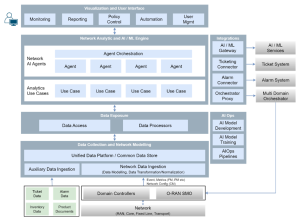
Achieving AI autonomous networks requires a robust architectural foundation. A blueprint architecture for AI autonomous networks highlights several key pillars:
- Unified Data Platform: Essential for comprehensive network data ingestion and modelling, consolidating all network data for holistic visibility. This platform handles data collection, network modelling, and auxiliary data ingestion, ensuring data transformation and normalization.
- Powerful AI/ML Engine: This engine is responsible for developing, training, and deploying AI/ML models that drive automated network operations and optimization. It includes network analytic capabilities, AI agents, and agent orchestration for various use cases.
- Integrated Operational Systems: Crucially, it requires seamless integration with existing operational systems (e.g., ticketing, alarms) and intuitive visualization and policy control interfaces to empower operators and manage the evolution towards full autonomy. This also includes integrations with AI/ML services and multi-domain orchestrators. A practical example of this in action is FieldMate AI, where agentic AI is applied directly to fieldwork automation, integrating ticketing systems, real-time guidance, and contextual intelligence to streamline telecom field operations.
- Visualization and User Interface: Providing monitoring, reporting, policy control, automation, and user management capabilities through a central UI is essential for managing the autonomous network.
What is Agentic AI?
At its core, Agentic AI refers to AI systems designed with a level of autonomy and purpose. These AI agents are not merely passive models; they are proactive entities capable of perceiving their environment, reasoning about their goals, making decisions, and taking actions to achieve those goals. This often involves:
- Goal-Oriented Behaviour: Agents are programmed to achieve specific objectives.
- Perception: They gather information from their environment (e.g., network telemetry, alarms).
- Reasoning and Decision-Making: They process information, infer insights, and decide on the best course of action.
- Action: They execute commands or trigger automated processes within the network.
- Learning: They can adapt and improve their performance over time through experience.
Agentic AI and Multi-Agentic AI in Autonomous Networks
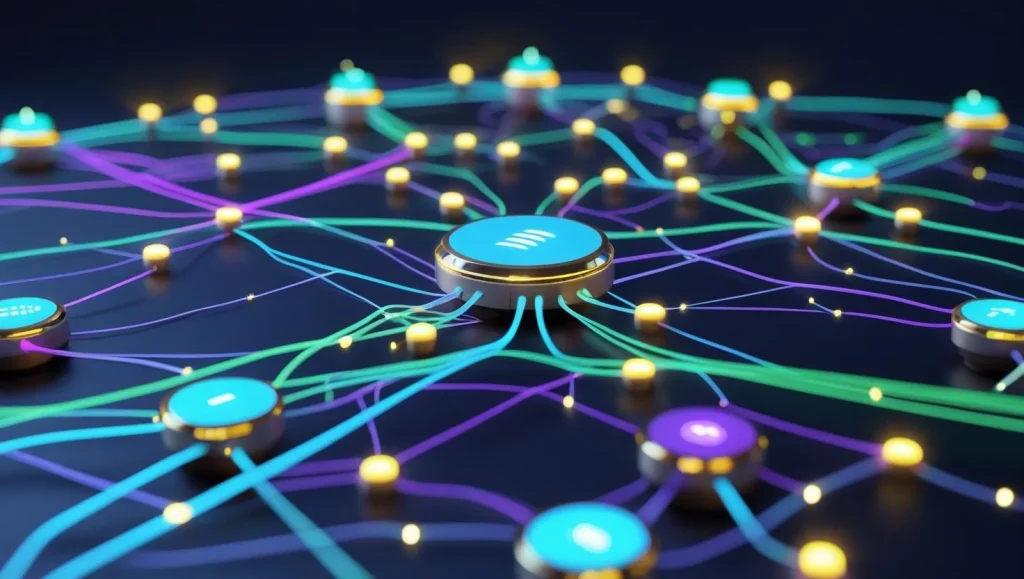
The shift towards autonomous networks is significantly accelerated by Agentic AI and, more powerfully, Multi-Agentic AI. Instead of a single, monolithic AI attempting to manage the entire network, Multi-Agentic AI employs multiple specialized AI entities, each focusing on a specific domain or task within the network.
Here’s how they work together to drive autonomous networks:
- Specialized Expertise: Individual agents can be designed for specific functions, such as anomaly detection, traffic optimization, or root cause analysis. This allows for deeper expertise and more efficient processing within their defined scope.
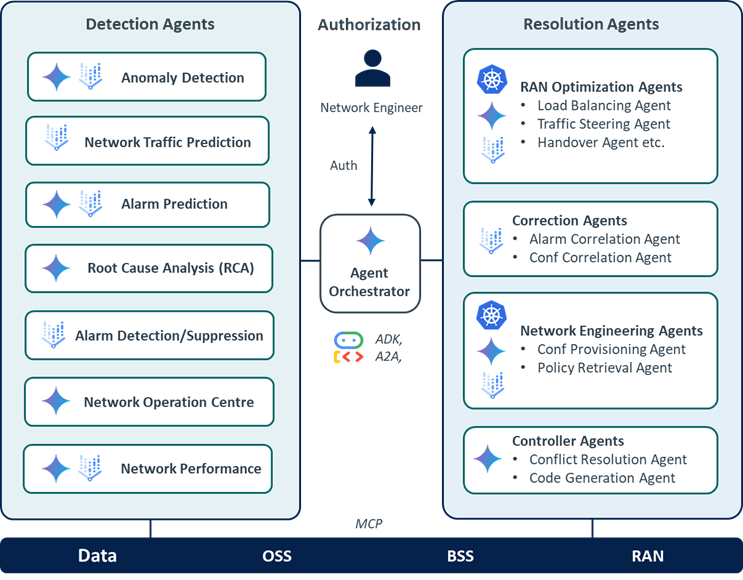
- Collaboration and Coordination: An Agent Orchestrator manages these diverse agents, enabling them to collaborate and coordinate their actions. For example, an anomaly detection agent might identify an issue, trigger a root cause analysis agent, which then informs a correction agent to resolve the problem.
- Real-time Optimization: Multi-agent AI enables networks to self-manage and optimize in real-time, with specialized AI entities collaborating to ensure seamless operation and dynamic resource allocation.
- Proactive Management: This leads to significantly improved efficiency, resilience, and adaptability, transforming network management from reactive to proactive and intelligent.
Zinkworks Solutions on AI Agents
Zinkworks offers a suite of AI agents designed to enable and enhance autonomous network capabilities:
Monitoring Agents: Proactive Network Intelligence
- Anomaly Detection Agent: Identifies deviations from standard patterns using machine learning to detect emerging issues before they escalate.
- Network Traffic Prediction Agent: Forecasts congestion points, enabling smarter resource allocation and maintaining service quality under dynamic conditions.
- Alarm Prediction Agent: Anticipates network faults by analysing KPIs, enabling pre-emptive intervention and reducing downtime and maintenance costs.
- Root Cause Analysis (RCA) Agent: Diagnoses underlying causes of network issues by correlating events and anomalies, providing actionable insights.
Optimization & Control Agents: Intelligent Network Management
- Network Performance Agent: Evaluates network health and efficiency in real-time, identifies bottlenecks, and ensures consistent service quality.
- RAN Optimization Agents: Dynamically adjusts network parameters, including Load Balancing, Traffic Steering, and Handover Agents, to optimize user experience.
- Correction Agents: Correlates data across events and configurations, automatically resolving inconsistencies and minimizing human intervention.
- Controller Agents: Manages conflicts autonomously and provides automated code deployment, maintaining stability during complex upgrades.
- Network Engineering Agents: Automates configuration tasks, enforces policy adherence, and reduces configuration errors.
Zinkworks’ multi-agent AI framework is built ground up leveraging Google Cloud Platform’s capabilities and AI-first principles, ensuring AI is ingrained into every feature. This platform-based approach with open APIs and a workflow editor enables developing custom applications and automations that precisely address CSPs’ needs. By leveraging these specialized AI agents, CSPs can move closer to fully self-managing and self-optimizing networks, transforming network operations for improved efficiency and resilience.
Ready to accelerate your journey toward Autonomous Networks?
Leverage Zinkworks’ multi-agent AI platform to unlock real-time optimization and proactive management. Talk to our experts to get started.