Shannon Retail Park, Dublin Rd, Athlone, Co. Westmeath, N37 E2P6
info@zinkworks.com

AI Driven Energy Management in Adaptive RAN Networks
The tools available for managing RAN energy have historically been blunt: static thresholds, fixed time windows, generic vendor defaults applied across thousands of cells with very different traffic profiles. Used aggressively, they hurt customers. Used cautiously, they save almost nothing.
That compromise has been the right call for a long time, because the alternative was worse.
But the tools have changed. The operators leading on network intelligence are no longer treating energy and experience as opposing pressures. They’re deploying RAN management systems sophisticated enough to deliver both at once, and they’re doing it by making the network adapt to what’s actually happening on it, in real time.
Why Static Rules Force the Wrong Trade-Off
To see why the trade-off is artificial, look at how it gets built into a network in the first place.
A capacity cell at a downtown business district sees one traffic profile. The same vendor radio sitting at a transit hub sees a completely different profile, with sharp bi-modal commuter spikes that align with departure and arrival schedules. A retail district peaks during business hours. A suburban residential cell inverts that pattern entirely, with traffic surging in the evening when commuters return home. A rural site might see localised peaks along traffic corridors and very little else.
The same is true of layer behaviour. In a simplified scenario where the lower frequency bands are prioritised for idle-mode UEs, a 700 MHz coverage layer carries the always-on connectivity blanket that subscribers rely on for basic service. The 1800, 2100, and 2600 MHz capacity layers carry the throughput when demand is high, and sit largely unused when it isn’t. Coverage layers must remain active. Capacity layers don’t.
A static rule (sleep these cells between 02:00 and 05:00) cannot reflect any of this. It treats every cell the same, ignores the specific traffic shape of the geotype it sits in, and gets calibrated for the worst case across the entire network. When operators set it conservatively, they protect QoE but capture maybe a third of the available savings. When they set it aggressively, they capture more savings but pay for it in the form of degraded experience for customers in cells where the rule didn’t fit.
This isn’t just an operator-side problem. The legacy tools (SON, vendor power-saving features) were built for a different era; rule-based, generic, not trained on the operator’s own data. What changes the picture is models that learn the specific traffic pattern of each cell, in each operator’s network. That’s where the false trade-off finally collapses: when the system understands the network well enough to know exactly when sleep is safe and when it isn’t.
What AI Driven Energy Management in RAN Networks Actually Looks Like
What changes the picture is reasoning in context, not in rules. Instead of asking what time it is, the system asks whether this specific cell, in this specific traffic state, with these specific neighbours, can safely sleep right now; and for how long.
In practice, that adaptation runs across several dimensions:
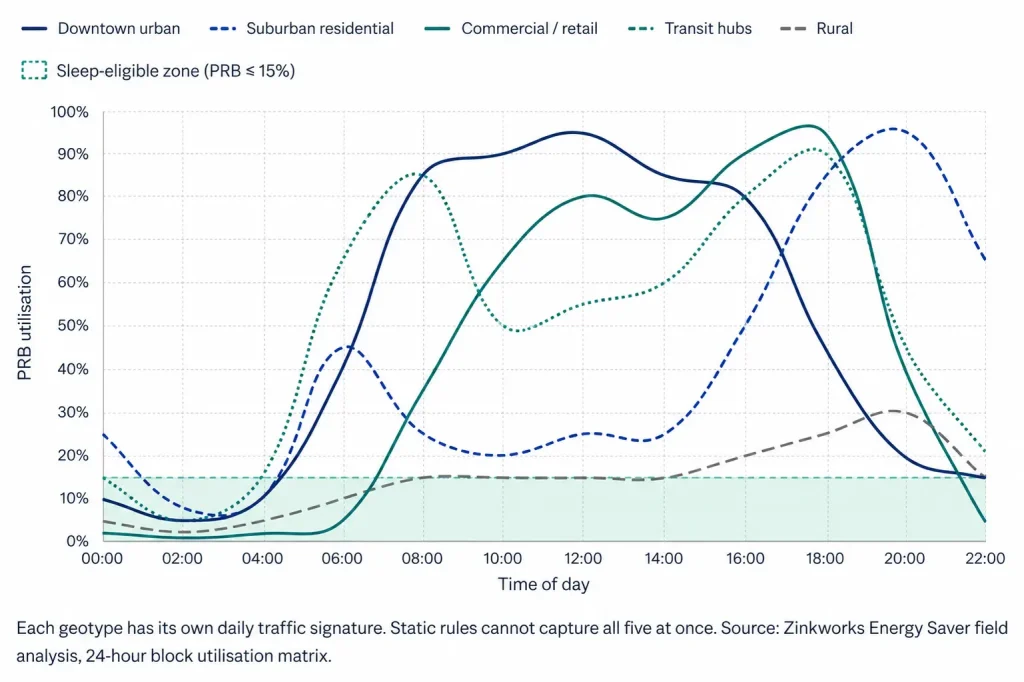
Time and traffic shape. Each geotype has its own 24-hour signature. Downtown business districts peak from 08:00 through 16:00 and drop sharply after 18:00. Transit hubs spike at commuter windows. Commercial and retail districts ride the business-hours curve. Suburban residential is the inverse of downtown. Rural sites have low baseline activity with localised peaks. The system learns these shapes from real network data and predicts forward, so the sleep window for a cell in a transit hub looks nothing like the sleep window for a cell in a residential suburb, even on the same Tuesday night.
Coverage and capacity separation. Only capacity layers are eligible for sleep, and only when their predicted PRB utilisation sits at or below a safe threshold. Coverage layers continue to serve the always-on connectivity that QoE depends on. The system knows the difference at every site.
Cell relationships, not just cell states. The network is reasoned about as the graph it actually is, where each cell sits in a topology of overlapping coverage, neighboring capacity, and dependent traffic flows. Putting a cell to sleep without understanding what its neighbours are carrying is how you cause handover failures. Understanding the relationship is how you avoid them.
Per-cell load prediction. Knowing that traffic will be low on average at 3am isn’t useful. Knowing whether this cell will safely sit below its sleep-eligibility threshold from 02:47 to 04:32, and whether the neighbouring capacity cell can absorb the residual load without degrading user throughput, is what makes autonomous action safe.
Hardware-specific power awareness. Different radio types have different power deltas. A modern AAU draws very differently from an older RRU, and the system accounts for this when calculating both the savings opportunity and the wake-up timing required to maintain QoE.
Confidence-bounded action with human oversight. Every recommendation carries a confidence level. Operators set the policy guardrails for what gets actioned automatically and what flows to a human-in-the-loop. Automated rollback is built in. This is what makes the system safe to run at production scale.
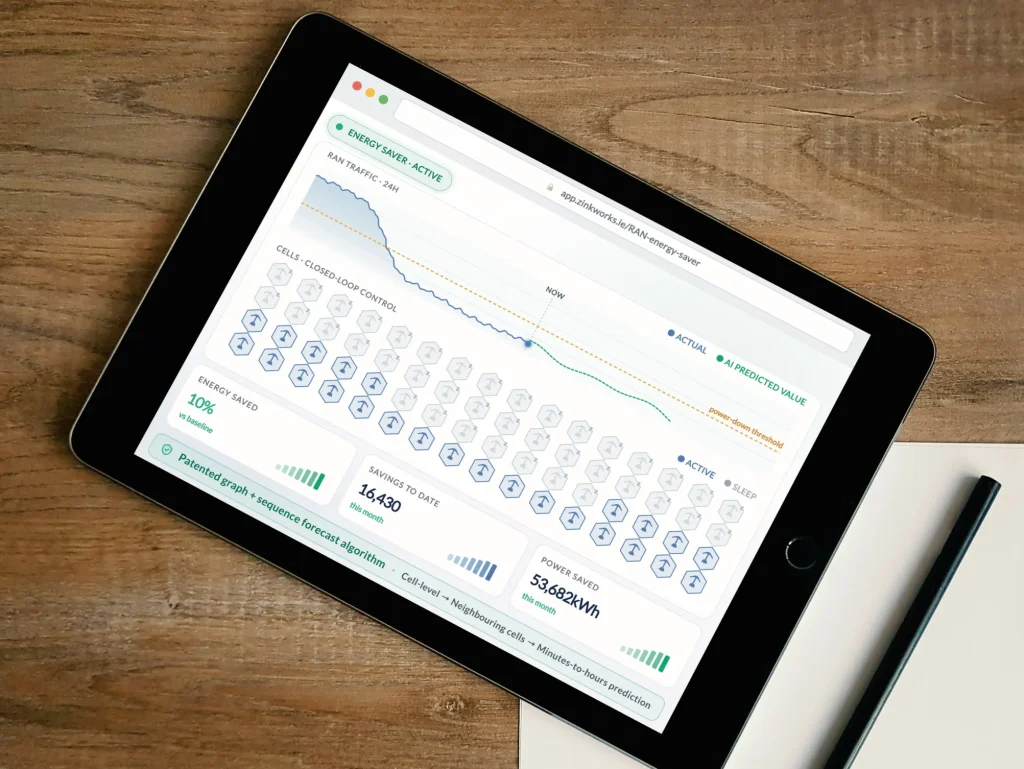
Zinkworks has built this capability around a patented AI traffic prediction model developed in-house. This model is at the heart of the “Energy Saver” product Zinkworks offers to operators. Energy management isn’t a standalone application. It runs on the same foundations that handle agent orchestration, model lifecycle management, governance guardrails, and human-in-the-loop oversight across our deployments. Models are continuously retrained as the network evolves. Recommendations flow through policy before any cell state changes. The same platform supports the next operational use case the operator decides to build, and the one after that.
The Evidence for AI-driven Energy Optimisation in Mobile Networks
To pressure-test the approach, Zinkworks ran detailed analysis on an actual operator network in a mid-sized European city, covering roughly 2,000 km² of mixed terrain, from dense downtown to coastal residential to inland rural, served by close to 2,000 capacity cells across LTE bands.
The modelling worked from real network data: cell-level traffic patterns over a full daily cycle, geotype classification across five categories (downtown urban, suburban residential, commercial/retail, transit hubs, rural/wide-area), coverage-versus-capacity layer separation, and per-cell power deltas based on the actual mix of installed radio hardware. Sleep-eligibility windows were derived geotype by geotype, anchored on when traffic predictions indicated PRB utilisation would safely sit at or below 15%, the threshold at which capacity cell sleep does not affect user experience because the load can be absorbed by coverage and neighbouring capacity layers.
The output: a modelled saving of roughly 4,700 kWh per day which compounds to around €140 per capacity cell per year in OPEX reduction at 2025 EU industrial energy rates. For the cluster modelled (one mid-sized European city’s worth of capacity cells), that’s an annual reduction od €280,000, with QoS thresholds protected throughout. That’s the savings opportunity for one mid-sized city’s worth of capacity cells. Scale that across a national footprint, and the numbers compound. To illustrate, an operator running 50,000 capacity cells nationally would translate that to around €7 million a year; a Tier 1 with 200,000 cells, around €28 million.
Stepping back to the wider industry signal: Vodafone has reported AI-driven energy savings of 14% per site in trials where AI replaced manual configuration of sleep parameters, with KPIs maintained throughout. That last clause is the important one. The savings are achievable. The interesting question, and the one this piece is really about, is whether the subscriber feels them. The published evidence increasingly suggests they don’t, provided the AI is smart enough to know when to act and when to hold back.
For operators carrying both an OPEX mandate and a customer experience mandate, this is the rare case where the right answer to one is the right answer to the other. Cut energy use materially, and protect QoE while you do it. The systems that deliver this aren’t experimental. They’re being deployed today.
The Forward Look, Zinkworks Energy Saver
The operators leading on RAN intelligence won’t be the ones who chose between energy savings and subscriber experience. They’ll be the ones who built the technical sophistication to stop having that argument.
Energy saving on RAN infrastructure is the rare use case in network operations that delivers only upsides. It saves real money on the electricity bill. It is straightforward to deploy with the right partner. It protects QoE for subscribers when designed properly. It involves no FTE reduction, so there’s no internal friction or transformation politics to navigate. And it supports the operator’s broader sustainability commitments without requiring a separate programme to deliver them. A triple win: for operators, for consumers, and for the environment.
Zinkworks is launching Energy Saver to make that triple win deployable, not just achievable. We will be presenting it at DTW Ignite 2026 in Copenhagen this June.
If you are running network operations and looking at energy as the next OPEX lever you can pull, come and talk to us. Bring the problem. We’ll show you how we would fix it.
FAQs
01 How does Zinkworks help operators reduce RAN energy consumption without affecting QoE?
Zinkworks Energy Saver helps operators identify when capacity cells can safely enter sleep mode while maintaining subscriber experience. By analysing traffic behaviour, network topology, and predicted utilisation patterns, the solution enables energy savings without compromising coverage, throughput, or service quality. This allows operators to pursue energy reduction goals while protecting QoE.