Author
Michael BehanSolution Architect
"*" indicates required fields
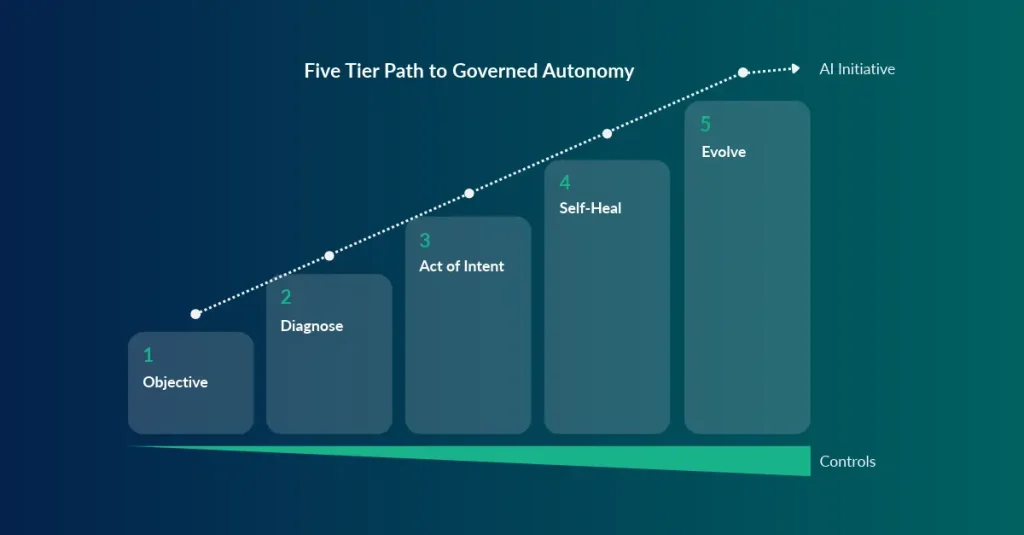
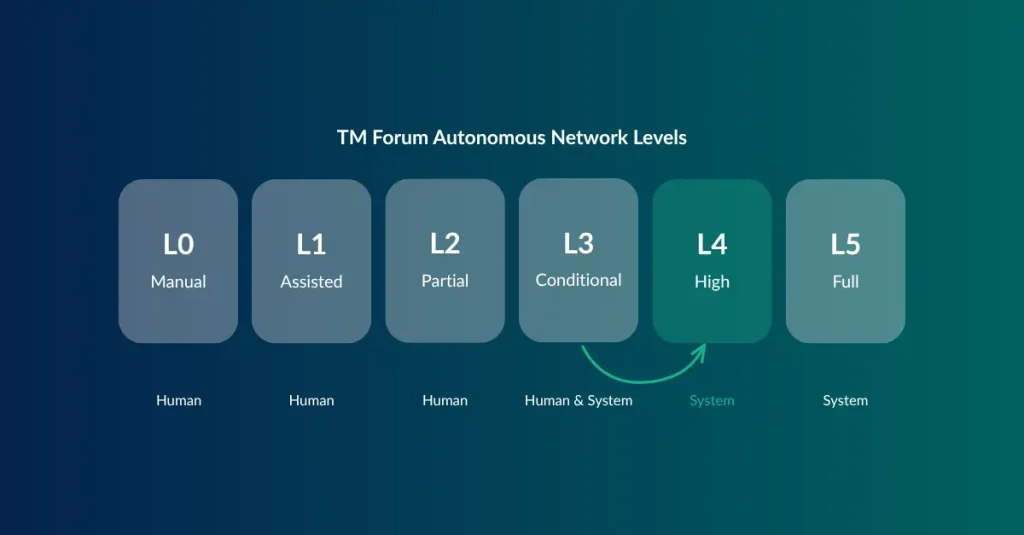
In our first blog, The Governance Gap Holding Operators Back from Level 4 Autonomy, explained why the move beyond Level 3 is as much a governance challenge as a technical one, and why autonomy has to be earned in stages. In the second blog, RAN Autonomy FAQ: The Five-Tier Path to Governed Autonomy, set out what those stages look like in practice: five tiers of RAN use cases, from observe and explain to evolving the automation itself, each with a matching step up in controls.
Both pieces arrived at the same rule: no agent ever gets a write path of its own. This article explains the architecture that makes that rule real, through six principles for governed autonomy in the RAN and five questions to ask any supplier who says their agents are ready to run your network.
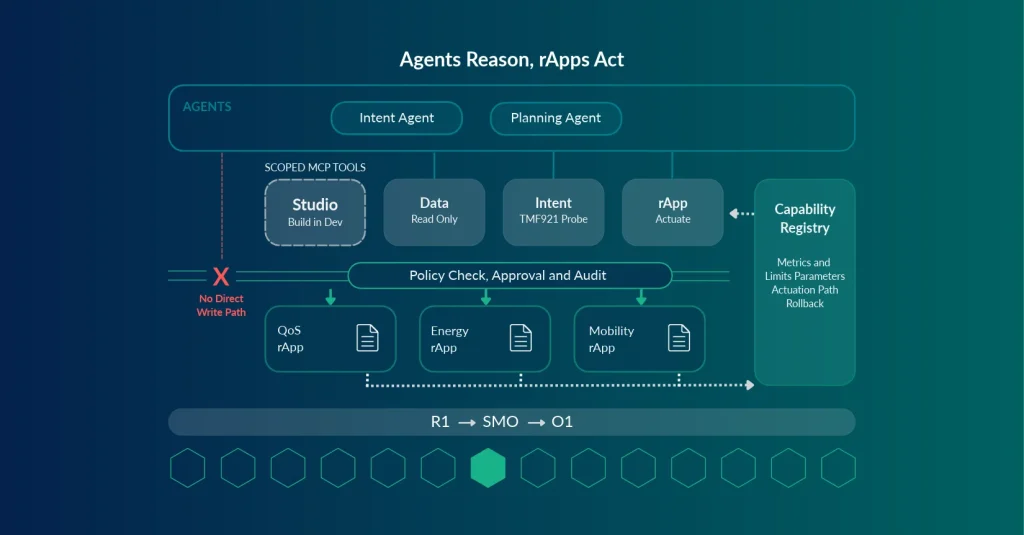
If you only take one thing from this piece, take this – Agents Reason, rApps Act.
Large language model-based agents are some of the best tool we have ever had for reasoning over messy operational data: alarms, tickets, KPIs, topology, SLA context, the engineer’s own runbooks. They are also non-deterministic, hard to certify, and impossible to hold accountable in the way a regulator or a board expects.
Certified rApps are the opposite. They are deterministic, testable, badged against the O-RAN R1 interface, and they already sit on the approved control path into the network.
So, the architecture writes itself. Agents supply the reasoning. Certified rApps perform the closed-loop network control. The certified O-RAN control path, R1 to the SMO to O1, is kept out of and there are no second, ungoverned write paths for an agent to discover.
This is not only an engineering preference. Under the EU AI Act, AI used as a safety component in the management and operation of critical digital infrastructure is classed as high-risk, with obligations around risk management, logging, human oversight, accuracy and robustness. The Commission’s draft guidance keeps routine network optimisation and load prediction out of that category for now. But every rung up the autonomy ladder moves a system from optimising the network towards operating it, and the burden of showing which side of that line you are on sits with the operator. An operator that lets an agent write directly to the RAN will, sooner or later, have to explain to someone why it did.
The architecture below is designed so that the explanation is easy.
In our rApp Studio, the six principles are not a policy document. They are the product.
rApp Studio is a no-code, SMO-portable environment where operator engineers design, train, validate and package rApps in days instead of three to six months of specialist handoffs. rApp Studio allows operators to preserve their intelligence and automation across SMOs and across vendors.
That same Studio is the governed route to evolve the automation. The rApp Studio Agent Edition adds an intent-led agent layer on top. Agents continuously reason over the RAN data lake and act only through rApps and the Studio, under the operator’s defined policies. Intent in, action out, with no parameter engineering.
If a supplier tells you their agents are ready to run your network, ask these five questions. The answers will tell you whether the architecture above is real or a diagram.
In the final piece of this series, James McNamara will bring the principles together: three live closed loops on one architecture, built with our research and industry partners, running on our stand at FYUZ 2026.
Attending FYUZ 2026 in Seattle, 3 to 5 November? Meet us at stand #14 to see how rApp Studio takes a use case from idea to live automation in days, and how governed agents act only through certified rApps or to book a demo.

“Agents Reason, rApps Act” is the Zinkworks architecture principle for using AI safely in Open RAN. Large language model based agents analyse operational data such as alarms, tickets, KPIs, topology and SLA context, then propose actions. Certified rApps carry out the actual closed-loop network control. This separates flexible AI reasoning from deterministic, accountable network execution.