
Author
Michael BehanSolution Architect
"*" indicates required fields
By Michael Behan, Solution Architect at Zinkworks, with 30+ years at Alcatel, Ericsson and Dell Technologies and an active contributor to the O-RAN Alliance and AI-RAN Alliance
Over the past few years Zinkworks engineers have worked inside the RAN operations of large European operators and operator groups. They all want a higher level of network autonomy, because it lets them introduce new services faster and improve quality of service at a pace that manual operations cannot match.
Their problem is also consistent. RAN engineers each look after hundreds of nodes and know where AI would help, for example in anomaly detection, energy management and QoS prediction. What they lack is a fast way to turn an idea into automation running on the network. A new rApp or SON application typically takes months of specialist handoffs, vendor dependencies, integration, testing and packaging, and by the time it is live the problem it was built for has often changed.
This has three consequences. The speed of automation is set by suppliers rather than by the operator’s own engineers. AI stays in isolated use cases, because each use case is a separate project. Operators also lack a benchmark or evaluation method for how an automated system behaves, which makes trust in it hard to measure.
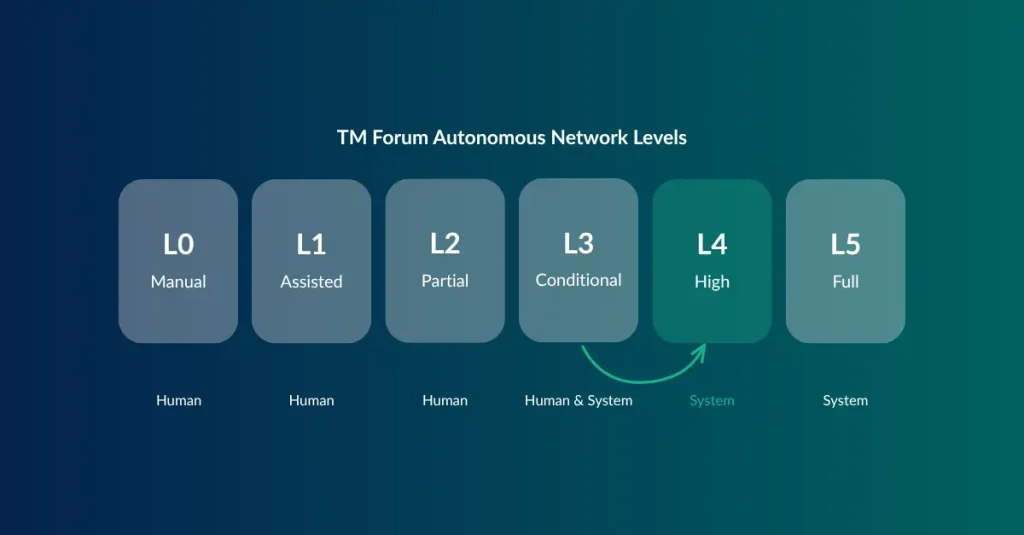
TM Forum’s Autonomous Networks levels, and the matching definitions in 3GPP TS 28.100, run from Level 0 (fully manual) to Level 5 (fully autonomous). At Level 3 the system performs all execution and awareness tasks and shares analysis and decision-making with people, who define the control information it works from. At Level 4 the system performs analysis and decision-making itself, and people and the system start to share the handling of intent. In practice a person no longer approves each action, because a policy does, and that changes who is accountable for a decision on a live network.
The figures show how far the industry has to go. TM Forum’s latest survey found 21% of respondents operating at Level 3 or above, up from 19% a year earlier, and at DTW Ignite in June TM Forum reported 40 validations awarded to 17 operators and found that 81% of operators are aiming for Level 4 or above by 2030. The Level 4 validations so far cover selected scenarios within a single domain, such as energy saving or fault management. TM Forum’s CTO, George Glass, has put the industry average at between about 1.5 and 2.1 and has warned: “If you leave your legacy and just start putting agents on top, you will not get to level four.”
The gap between Level 3 and Level 4 is therefore a governance problem as well as a capability problem. It is about who is allowed to act, through which path, under which policy and with what record.
In July the RAN Intelligence and Automation subgroup of TIP’s OpenRAN Project Group published a white paper on SMO evolution and agentic AI. It states the objective as “governed autonomy: greater operational speed and coordination without removing accountability or control”, and it argues that agentic AI should be considered during the 6G study phase rather than added afterwards. That study work is under way now, so an operator that wants Level 4 operations, with a credible path to Level 5, needs to start building the governance layer before the next vendor release rather than after it.
Our view, based on work with operators on live networks, is that autonomy should be added in stages. Each increase in what the system may decide needs a matching increase in the controls around it: the policy that limits it, the path it may act through and the audit record that lets a person replay what happened.
Operators can start benefiting before they reach a fully autonomous network. They need a starting point that matches their current maturity and a path that keeps what they build along the way.
In the next article, James McNamara describes that path: five tiers of use case, from observe and explain to evolving the automation itself, with the controls each tier needs.
Zinkworks is at FYUZ 2026 in Seattle on 3–5 November, at booth #14. If you are working on the same step, come and talk to the engineers who built rApp Studio.

At Level 3, the network performs all execution and awareness tasks, but analysis and decision-making are shared with people, who define the control information the system works from. At Level 4, the system performs analysis and decision-making itself, and people and the system share the handling of intent. In practice, a policy rather than a person approves each action, which changes who is accountable for decisions on a live network.